
Disclosure: If you invest through our links, we may earn a small commission at no extra cost to you. This article is for informational purposes only and does not constitute financial advice.
Last Updated: February 7, 2026
If you pull up a 12-month silver price chart today, you might experience a touch of financial vertigo.
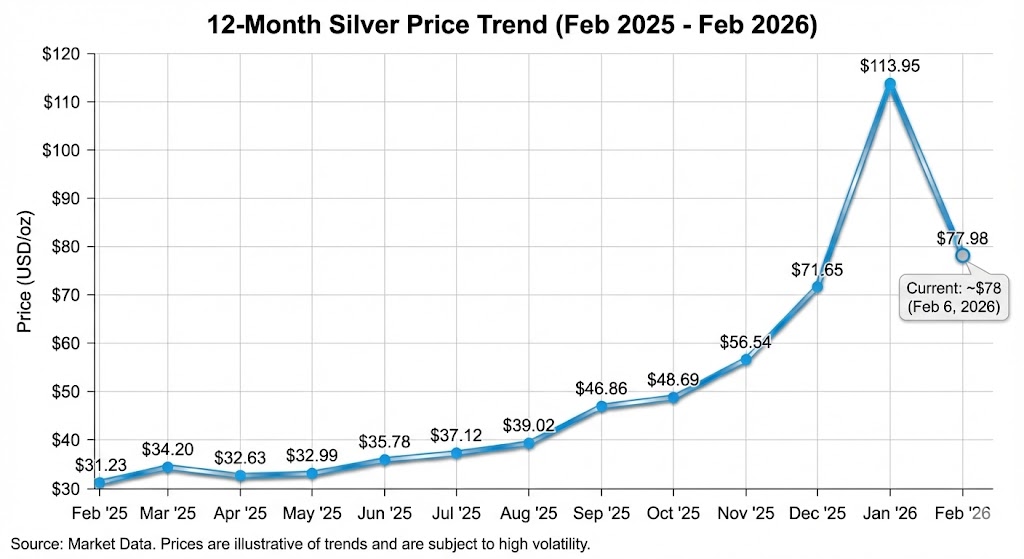
Exactly one year ago, in February 2025, silver was battling to break through the stubborn $30 resistance level—a ceiling that had capped the market for nearly five years. Today, spot silver sits at roughly $85.00 per ounce, representing a staggering gain of nearly 180% in just twelve months.
For the average investor, this vertical line looks terrifying. It screams “Bubble.” It invokes memories of the 1980 Hunt Brothers squeeze or the 2011 peak. The natural instinct is to sell, take profits, and wait for the inevitable crash back to reality.
But here is the reality of 2026: This is not a speculative bubble. This is a fundamental repricing. The chart you are looking at is not measuring the value of silver going up; it is measuring the value of the dollar collapsing against a critical industrial asset that is in severe shortage. The “Crash” has already happened—it happened to the currency you use to buy the metal.
This article breaks down the technical and fundamental anatomy of the last 12 months, explaining why the move from $30 to $85 was not a fluke, but a mathematical inevitability driven by the “Solar Squeeze” and the bond market failure.

Visualizing the Chart: The “Staircase to Heaven”
To understand where we are going, we must dissect how we got here. The 12-month chart for silver (Feb 2025 – Feb 2026) reveals a clear pattern of “Impulse and Consolidation”—a bullish staircase that indicates sustained institutional buying rather than retail mania.
Phase 1: The Breakout (Q1 2025)
-
The Level: $30.00 – $35.00
-
The Trigger: In March 2025, the Federal Reserve signaled that it could not lower interest rates despite a slowing economy, acknowledging that inflation was “sticky” at 4-5%.
-
The Move: Smart money realized the “Fed Put” was dead. Capital fled the crashing bond market and rotated into hard assets. Silver shattered the multi-year ceiling at $30, closing the quarter near $38.00.
Phase 2: The “Solar Panic” (Q2 & Q3 2025)
-
The Level: $38.00 – $60.00
-
The Trigger: This was the most violent leg of the rally. In June 2025, major solar manufacturers (First Solar, JinkoSolar) issued warnings that they could not source enough silver paste for the new TOPCon panels.
-
The Move: Industrial panic buying set in. Samsung and Tesla began bidding directly for physical inventory, bypassing the COMEX futures market. This “Supply Shock” drove the price vertically through $50, hitting $62.00 by late August.
Phase 3: The Consolidation (Q4 2025)
-
The Level: $60.00 – $75.00
-
The Trigger: Profit-taking. After doubling in six months, traders naturally sold to lock in gains.
-
The Significance: Crucially, the price did not crash back to $30. It held a “Higher Low” at $60, proving that the new buyers were not speculators, but industrial users who needed the metal to keep factories running. This built a massive base of support.
Phase 4: The Sovereign Breakout (Jan – Feb 2026)
-
The Level: $75.00 – $85.00+
-
The Trigger: The return of Sovereign Buyers. In January 2026, data revealed that the BRICS nations (specifically China and India) had resumed massive accumulation of silver reserves to back their digital currencies.
-
The Move: This broke the consolidation pattern, pushing us to the current level of $85.00. We are now in “Blue Sky” territory with no historical resistance overhead.
1 Year Silver Price Chart
Fundamental Driver #1: The “TOPCon” Effect
While traders look at charts, manufacturers look at inventory. The primary engine behind the 2025-2026 breakout is a massive structural shift in the solar energy sector known as the “TOPCon Transition.”
For years, the standard solar panel technology was PERC (Passivated Emitter and Rear Cell). In late 2024, the industry began an aggressive pivot to TOPCon (Tunnel Oxide Passivated Contact) cells to achieve higher efficiency.
-
The Math: TOPCon cells require 50% to 80% more silver per unit than the older PERC models.
-
The Shock: Analysts in 2024 predicted this would increase demand slowly. They were wrong. The transition happened nearly overnight as Chinese manufacturers retrofitted factories to dominate the market.
The Vault Drain & Backwardation
This sudden spike in industrial demand—estimated at an additional 150 million ounces in 2025 alone—drained the global vaults. The chart reflects this through a phenomenon called Backwardation.
-
Normal Market: Usually, the “Future Price” of silver (delivery in 6 months) is higher than the “Spot Price” (delivery today) because of storage and insurance costs.
-
2026 Market: throughout late 2025, the Spot Price traded higher than the Futures Price.
-
The Signal: This is a screaming siren that indicates physical shortage. Manufacturers like Samsung, Tesla, and JinkoSolar were willing to pay a premium to get the metal now rather than wait, fearing the vaults would be empty later. This physical desperation is what built the floor at $60.00.
Fundamental Driver #2: The Monetary Premium
If industrial demand built the floor, monetary panic built the ceiling.
For decades, silver traded primarily as an industrial commodity (like copper). In 2026, it has re-coupled with its historical role as Monetary Metal.
Chasing Gold ($4,800)
Silver rarely moves alone. It typically follows Gold, but with higher volatility (like a leverage play).
-
Gold’s Move: As Gold broke through $3,000 and marched toward its current level of $4,800, it dragged the entire precious metals complex upward.
-
The Ratio Compression: In early 2025, the Gold-to-Silver Ratio was a sluggish 85:1 (meaning it took 85 ounces of silver to buy 1 ounce of gold). As of February 2026, that ratio has compressed to 56:1.
-
The Implication: This signals that silver is outperforming gold on a percentage basis. Investors are realizing that at $85, silver is still historically cheap compared to $4,800 gold. The “catch-up trade” is in full swing.
The “Fed Put” Failure
The chart also visualizes a loss of faith in the Federal Reserve. Throughout 2025, the Fed attempted to talk down inflation while keeping interest rates high. But with US debt passing $40 Trillion, the market realized the Fed is trapped. They cannot raise rates high enough to kill inflation without bankrupting the Treasury.
-
The Result: The dollar is devaluing in real terms. Silver is not necessarily becoming “more valuable”—the measuring stick (the dollar) is shrinking. The chart is simply a reflection of this currency debasement.
Technical Analysis: Key Levels to Watch
Now that we understand why the price is moving, let’s look at where the charts suggest it is going next.
Technicians who study long-term cycles often refer to the “Cup and Handle” pattern—a massive multi-year formation that signals explosive upward momentum. In 2025, silver finally completed the “Handle” portion of a 45-year cup (dating back to the 1980 peak).
The Breakout Target: $120+
The completion of this pattern suggests a “measured move” significantly higher than current levels.
-
The Theory: When an asset breaks a multi-decade resistance (like $50), it typically rallies by the depth of the cup.
-
The Projection: Technical models project a medium-term target of $120.00 to $135.00 per ounce by late 2026 or early 2027.
Support & Resistance Levels
For traders looking to enter or add to positions, these are the critical zones on the chart:
-
Major Support ($70.00): This level, which was fierce resistance in late 2025, has now flipped into a “Hard Floor.” Institutional buyers stepped in aggressively at $72 in January, confirming that the market will defend this zone. Any dip near $70 is a screaming buy signal.
-
Psychological Resistance ($100.00): The next major hurdle is the triple-digit barrier. Expect significant volatility and profit-taking as we approach $98-$100. Humans like round numbers, and algorithms are programmed to sell here.
-
Blue Sky Breakout ($100+): Once $100 is breached convincingly, there is literally no historical resistance. The price enters “price discovery mode,” where moves can become parabolic (vertical).
Conclusion: Is It Too Late?
Looking at a chart that has gone from $30 to $85 in twelve months forces a difficult question: “Did I miss the boat?”
The answer depends on your timeframe.
-
If you are a day trader: Yes, the easy money has been made. Buying at $85 carries short-term risk of a pullback to $75 or $70.
-
If you are an investor: No, the trend is just beginning.
The Verdict: A Trend in Motion
The 12-month chart of 2025-2026 is not a picture of a bubble popping; it is a picture of a currency collapsing. The fundamental drivers—the Solar Squeeze, the Debt Spiral, and the Sovereign Buying—are not temporary anomalies. They are structural changes to the global economy that will persist for years.
Silver at $85 is merely catching up to the reality of $4,800 Gold and a $40 Trillion US Debt. While volatility will remain high (expect $5 and $10 swings on any given day), the strategy for 2026 remains clear: Buy the Dip. Do not chase green candles, but when red candles appear, treat them as a gift from a market that is slowly realizing it has run out of physical metal.


